Calling to schedule an appointment?
Posted By

Beyond hearing aids: Cochlear implants replace silence with sound

Do you struggle to hear a conversation in a noisy restaurant or are told that the volume of your TV is too high? You may have some hearing loss.
You aren't alone because over 37 million adults in the U.S. have trouble hearing. Hearing aids can increase your ease of hearing. Cochlear implants are another option for some people when hearing aids no longer work well.
Hearing basics
To hear, the ear needs to convert sound waves into electrical signals for the brain to interpret. The outer ear funnels sound waves to the eardrum and middle ear bones, where waves are converted into vibrations. Then the vibrations are transferred to the fluids of the cochlea, which is a snail-shaped chamber in the inner ear. Tiny sensors that line the cochlea convert the vibrations into electrical impulses that are transferred along the auditory nerve to the brain.
Damage to the cochlea sensors can cause partial or complete hearing loss. It could be caused by a genetic condition, age, noise exposure, illness or medication.
Cochlear implants
Hearing aids amplify sound and use people's residual acoustic hearing. It makes sound waves louder as they pass through the ear into the inner ear. They are not effective for people who are unable to perceive sound waves anymore due to cochlea damage.
A cochlear implant doesn't make sounds louder. Instead, it bypasses the parts of the ear that aren't working correctly, specifically the missing or damaged cochlea sensors. It uses electricity to stimulate the auditory nerve directly.
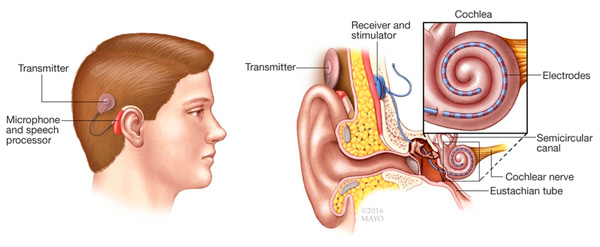
There are a few parts of a cochlear implant. A small bundle of wires, called an electrode array, is inserted into the cochlea and attached to a small device surgically implanted under the skin behind the ear. The device includes a stimulator that sends tiny electrical currents into the cochlea and the auditory nerve. It also has a receiver that gets sound signals from the external microphone and processor that sits behind the person's ear.
Cochlear implant candidates
Not every person with hearing loss can receive a cochlear implant. Good candidates are patients who are deaf, have moderate-to-profound hearing loss in both ears, or have profound and severe hearing loss in one ear.
These patients usually have a hard time maintaining a conversation on the phone, understanding people in noisy environments, distinguishing between multiple conversations in noisy settings or have not benefited from using traditional hearing aids. Many also tend to avoid social situations because they feel isolated and are unable to participate in the conversations around them. About 118,000 adults in the U.S. have received a cochlear implant.
Implantation surgery
During surgery, the surgeon makes an incision behind the ear and creates a space in the mastoid bone. Doing this creates a passage to the middle ear space, and the surgeon inserts the electrode array into the cochlea. After that, the implantable device is secured to the mastoid bone and the surgeon closes the incision.
The surgery takes two to four hours, and most people can go home the same day. Patients need to rest for a few days after surgery and avoid strenuous activity and heavy lifting. The surgical risks for this procedure are low, but it could cause facial weakness and dizziness. These are rare and, in most cases, temporary.
Implant activation
Usually, the implant is not turned on immediately after surgery because the incision is given a few weeks to heal. The patient then meets with the Audiology team to activate the implant. At this point, the patient will begin to hear again or for the first time in their life. Most of the time, this is an emotional moment for the patient, their family and the care team.
Implants need to be programmed, which audiologists do with the patient over several months after surgery. This optimizes and tunes the implant to the patient's hearing loss. Audiologists are critical members of the cochlear implant team because they identify patients who may be good candidates for implants and conduct ongoing care after the surgery.
Life after activation
Outcomes after cochlear implantation generally are good. On average, patients can expect improvement in their ability to understand speech and words by about six to seven times with the cochlear implant over what they could hear before the surgery.
Patients can turn the external processor off and on. They also can remove the external portion of the implant completely when they don't want to use it, which effectively turns it off. There are waterproof external processor options so patients can swim and bathe without removing their implants. Most patients opt to take the external portion off while sleeping, but it also can remain in place.
Talk with your health care team about your hearing loss and ask if a cochlear implant is a possible treatment for you.
Nathan Connell, M.D., is an otolaryngologist and head and neck surgeon in Eau Claire and Rice Lake, Wisconsin, who performs adult cochlear implant surgery.